Back
Back



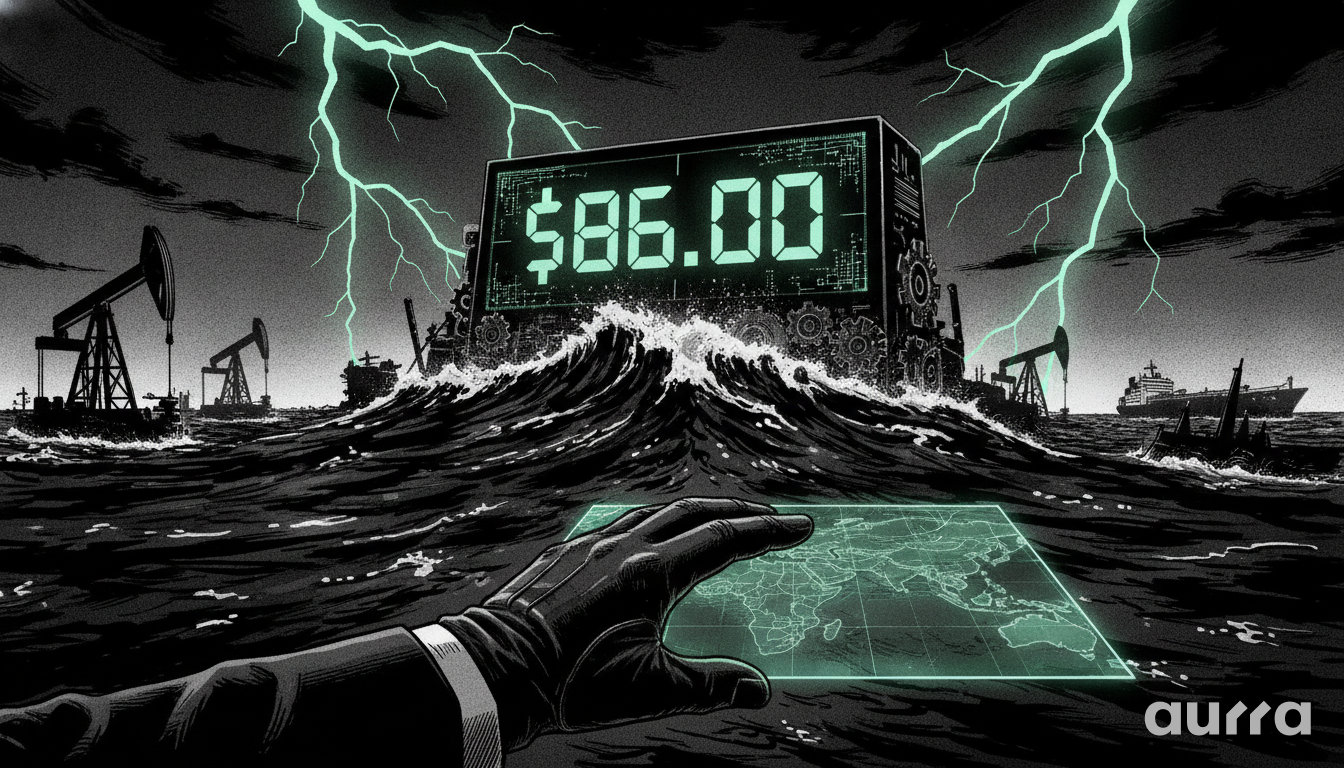
Why Has Brent Crude Slumped to the $88 Mark?
Brent crude oil has experienced a significant slide to the $88 per barrel level, driven by a powerful shift in the geopolitical landscape that has prompted a major reassessment of supply risks. This rapid repricing highlights how sensitive the energy market is to diplomatic signals, forcing traders to look beyond simple supply-and-demand metrics and focus on the nuances of global politics.
Decoding the Geopolitical Drivers
The recent sell-off is not a story about falling demand but rather about easing supply fears. When geopolitical tensions rise in key oil-producing regions, the market adds a 'risk premium' to the price. The current move to $88 is the direct result of this premium being swiftly removed.
The Impact of Sanctions Rhetoric
Uncertainty surrounding international sanctions on a major oil producer is a primary catalyst. Any hint that sanctions may be eased, or not enforced as strictly as previously thought, can immediately increase the expected global supply, putting downward pressure on prices. This factor is a key reason for the current weakness.
De-escalation and the Risk Premium
The market thrives on certainty. Fresh signals of de-escalation between conflicted nations reduce the likelihood of a sudden supply shock. We can look to historical precedent, such as the market's reaction to prior OPEC+ agreements or Iran nuclear deal progress, to see a clear pattern: as the perceived risk of conflict falls, the price of oil corrects downward to reflect a more stable supply outlook. This is precisely what we are witnessing now.
A Technical Perspective on the $88 Level
While fundamentals have provided the catalyst, technical analysis gives us a roadmap for what may come next. The $88 level is not arbitrary; it likely represents a key area of prior support or resistance that is now being tested.
Identifying the New Trading Range
Following such a sharp drop, the market will seek to establish a new, lower trading range. The $88 level now serves as a pivotal support zone. If it holds, we could see a period of consolidation as the market digests the new geopolitical reality. In these conditions, managing costs is key, which is why our platform's highly competitive, low-cost spreads are a direct advantage for range-bound traders.
Potential Downside Targets
If the bearish momentum continues and the $88 support level breaks, the next logical targets for sellers would likely be found at the $85 psychological level, followed by longer-term support zones. Traders should be prepared for this possibility, as the removal of a risk premium can often lead to an exaggerated move to the downside.
The Role of Inventory Data
While geopolitics are in focus, traders must not forget the weekly oil inventory reports (such as the EIA report in the U.S.). A surprise draw in inventories could provide a short-term boost and challenge the bearish narrative, while a significant build would add further weight to the sell-off.
Broader Market Impact and Strategy
The fall in oil prices has wide-ranging consequences for the global economy and various financial assets. For the prepared trader, this creates a host of new opportunities and risks to manage.
Implications for Inflation and Currencies
Lower oil prices are generally disinflationary, which could influence central bank policy down the line. This event also directly impacts commodity-linked currencies. The Canadian Dollar (CAD) and Norwegian Krone (NOK), for instance, often weaken in line with falling oil prices. Our reliable 99.9% platform uptime ensures you can act on these correlated moves without delay.
The Next Actionable Step
If the market continues to price in a more stable global supply outlook, a test of the $85 support level is a high probability scenario. Before positioning for such a move, it is crucial to manage risk appropriately. We recommend using the Aurra Markets Trading Calculator to model the potential outcomes and determine a position size that aligns with your risk management strategy.
Key Takeaways
- Brent crude oil fell to $88 due to an easing of geopolitical tensions and a removal of the market's 'risk premium'.
- Doubts over the severity or enforcement of international sanctions are increasing the expected global supply.
- The $88 level is now a critical technical support zone to watch.
- A break below $88 could open the door to a deeper correction towards the $85 mark.
- Lower oil prices have broad implications for inflation and commodity-linked currencies like CAD and NOK.
Geopolitical headlines are notoriously unpredictable. How do you factor events like this into your overall trading strategy for a volatile asset like oil?
Risk Disclosure: Any opinions, news, research, market analysis, pricing, or other information contained on this website is provided as general market commentary for informational purposes only, and does not constitute investment advice. Aurra Markets shall not accept liability for any loss or damage, including without limitation to, any loss of profit, which may arise directly or indirectly from the use of or reliance on such information.