Back
Back


What's Driving the Aussie and Kiwi Dollars Lower?
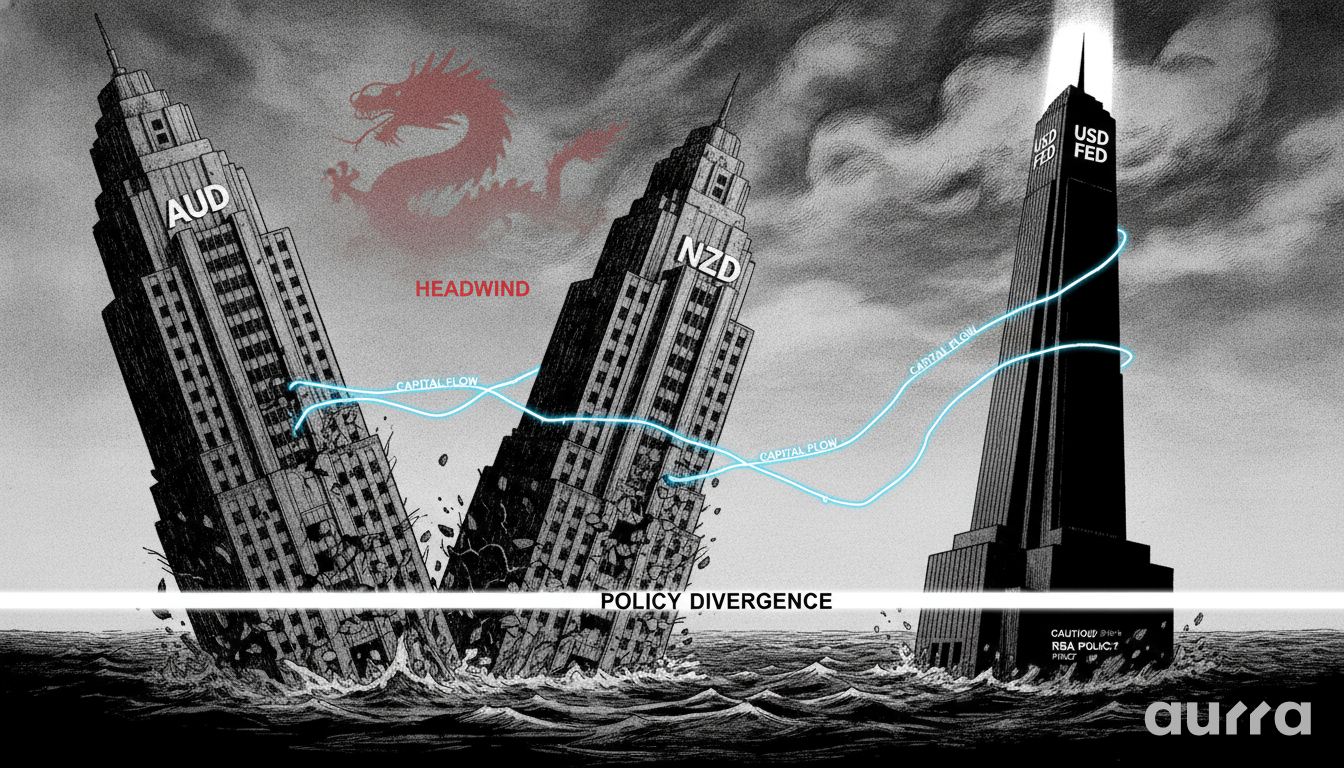
The Australian and New Zealand Dollars are under significant pressure as US Dollar strength dominates the forex market. This isn't just a technical breakdown; it's a fundamental divergence in central bank policy that traders must understand to anticipate the next major move. The weakness in these commodity-linked currencies reflects a widening gap between the Federal Reserve's firm stance on inflation and the more cautious outlooks of the RBA and RBNZ.
The Great Divide: Central Bank Policy Divergence
The engine driving the pronounced downtrends in AUD/USD and NZD/USD is the starkly contrasting monetary policy paths being forged by the respective central banks. While on the surface it looks like simple USD strength, the reality is a multi-layered narrative of economic resilience in the US versus growing headwinds in the Antipodean economies. This policy divergence is the single most important factor for traders to grasp right now, as it creates a powerful, persistent trend.
Federal Reserve's Unwavering Stance
The US Federal Reserve has remained resolute in its mission to bring inflation back to its 2% target. Recent inflation data, while showing some signs of moderation, has not been convincing enough for the Fed to signal a dovish pivot. This commitment to maintaining higher interest rates for a longer period makes the US dollar more attractive to investors seeking higher yields, a concept known as 'carry trade' interest. This sustained demand for the dollar creates a challenging environment for all other major currencies, especially those whose central banks are not matching the Fed's hawkish tone.
RBA and RBNZ: A More Cautious Tone
In contrast to the Fed, both the Reserve Bank of Australia (RBA) and the Reserve Bank of New Zealand (RBNZ) have adopted a more measured, even slightly dovish, tone. Facing concerns about slowing domestic growth and the impact of higher rates on heavily indebted households, neither central bank is projecting the same level of monetary hawkishness. This creates a clear interest rate differential that works against the AUD and NZD. When traders can earn more by holding US dollars, capital naturally flows away from the lower-yielding currencies, fueling the downtrend we are currently witnessing.
The China Factor: A Headwind for the Aussie
For the Australian Dollar (AUD), there is an additional layer of complexity that is critical to understand: its status as a proxy for the Chinese economy. China is Australia's largest trading partner, and its demand for Australian commodities like iron ore is a key driver of the Aussie's value. Recent economic data from China has been mixed, pointing to a potentially uneven and slower-than-expected recovery. This uncertainty weighs heavily on the AUD, acting as a persistent headwind that the NZD does not face to the same degree.
Decoding the Charts: Key Levels for AUD/USD & NZD/USD
With the fundamental backdrop of policy divergence firmly established, the technical charts provide us with a precise map of market sentiment and key inflection points. The recent price action has confirmed bearish control, with both pairs breaking below significant structural levels, indicating that the path of least resistance remains to the downside.
AUD/USD: Below the Trendline, What's Next?
The AUD/USD's break below the long-standing ascending trendline near 0.6650 was a significant victory for the bears. This level has now flipped from support to resistance. The immediate focus is on the horizontal support around 0.6580. A decisive break and close below this level would signal a continuation of the downtrend and bring the psychological 0.6500 handle into play. In a fast-moving market like this, execution speed is critical. Our platform's 99.9% uptime and ultra-fast execution ensure that you can act on these key breaks without delay.
NZD/USD: Testing Multi-Month Lows
The NZD/USD is arguably in a weaker technical position, having already broken to new multi-month lows. The pair is showing clear bearish momentum, with the next major support zone not appearing until the 0.6050 area. The prior support level, around 0.6100, will now act as a formidable resistance ceiling. Sellers will likely look to defend this level on any corrective bounce. The clarity of this downtrend presents a valuable learning opportunity for traders using a Demo account to practice identifying and trading with a dominant trend.
Strategic Framework for Navigating the Downtrend
Trading in a strong, trending market requires a specific strategic mindset. It's not about predicting the bottom, but about managing risk and identifying high-probability entry points that align with the prevailing momentum. Discipline is the cornerstone of success in these conditions.
Risk Management in High-Momentum Markets
Strong downtrends can be punctuated by sharp, volatile pullbacks. This makes disciplined risk management absolutely essential. Before entering any trade, it is crucial to define your stop-loss and take-profit levels. Our Trading Calculator is an invaluable tool for this, allowing you to model potential trade scenarios and determine appropriate position sizing based on your account balance and risk tolerance. This removes the guesswork and helps you trade with a clear, pre-defined plan, which is vital for long-term success.
Identifying Counter-Trend Opportunities
While trading with the trend is the higher-probability approach, learning to identify signs of bearish exhaustion is an important skill. Look for bullish divergence on momentum indicators like the RSI, or the formation of reversal patterns on key support levels. These signals do not guarantee a reversal, but they can indicate a pause in the downtrend and offer short-term opportunities. However, these are advanced techniques and should be approached with extreme caution and smaller position sizes until mastered.
If AUD/USD breaks and closes below the 0.6580 support level, a slide towards 0.6500 becomes highly probable. Keep a close eye on the upcoming US CPI data via the Aurra Economic Calendar, as a hotter-than-expected print would reinforce Fed hawkishness and likely accelerate the sell-off in commodity currencies.
Key Takeaways
- A significant monetary policy divergence between the hawkish US Federal Reserve and the more cautious RBA and RBNZ is driving AUD/USD and NZD/USD lower.
- Uncertainty surrounding China's economic recovery is an additional fundamental headwind specifically for the Australian Dollar.
- AUD/USD has broken a key trendline, with 0.6580 now serving as critical support.
- NZD/USD is testing multi-month lows, showing clear bearish momentum with the next major support near 0.6050.
- Effective risk management and trading with the dominant trend are crucial strategies in the current market environment.
Given the current central bank divergence, do you believe the Australian Dollar or the New Zealand Dollar is more vulnerable to further declines in the second half of the year? Let us know your reasoning in the comments.
Risk Disclosure: Any opinions, news, research, market analysis, pricing, or other information contained on this website is provided as general market commentary for informational purposes only, and does not constitute investment advice. Aurra Markets shall not accept liability for any loss or damage, including without limitation to, any loss of profit, which may arise directly or indirectly from the use of or reliance on such information.