Back
Back


Why Are the S&P 500 and Nasdaq Selling Off?
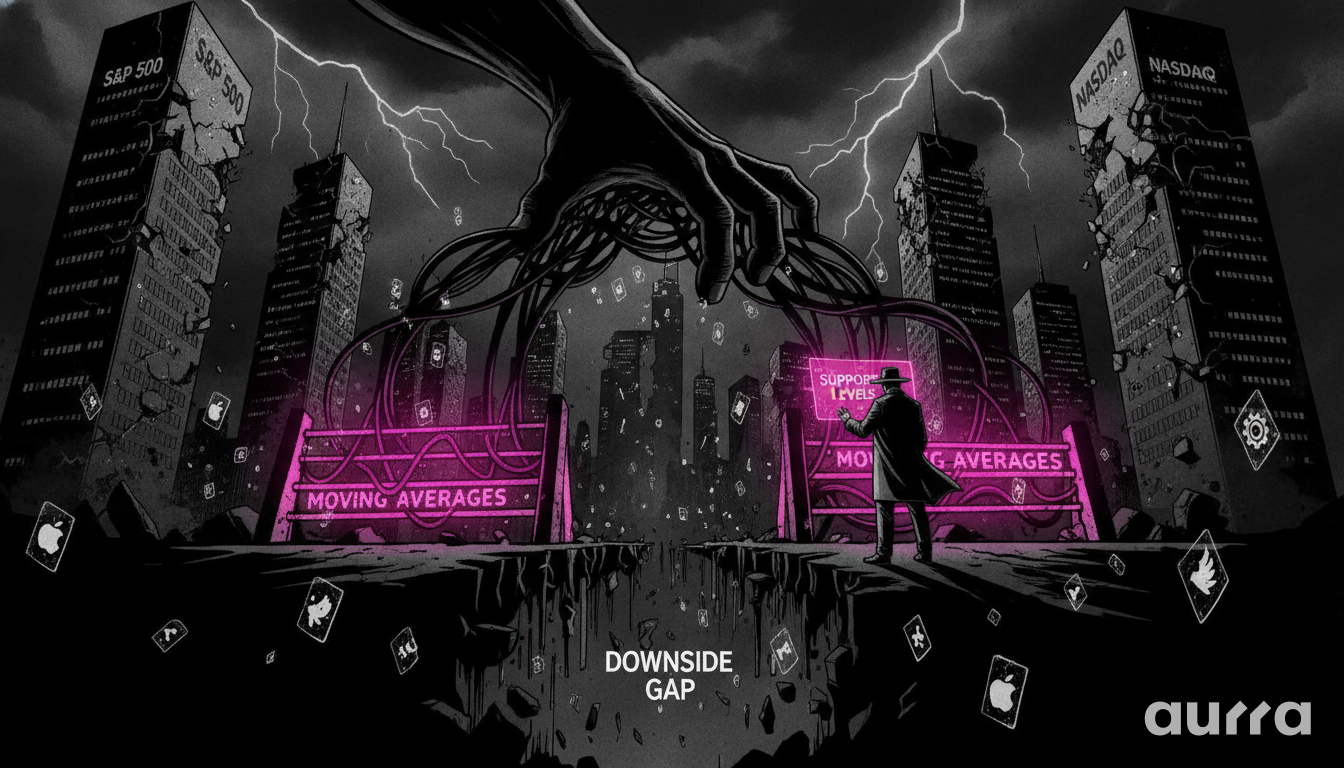
A significant overnight gap down has placed the S&P 500 and NASDAQ under heavy selling pressure, breaking key technical structures. This shift in momentum puts sellers firmly in control in the short term, requiring traders to reassess risk and identify new critical support levels.
Technical Breakdown: The Battle at the Moving Averages
The recent price action in US indices is a classic example of a sentiment shift driven by a technical breakdown. When markets gap below widely-watched technical indicators like the 100 and 200-hour moving averages, it often triggers algorithmic selling and forces traders who were positioned for a rise to liquidate, adding fuel to the fire. This is not just a minor fluctuation; it's a statement of intent from sellers, establishing new lines in the sand that define the current battleground. As traders, our job is to respect these new levels and understand the psychology driving the price action.
S&P 500: Resistance at the 7,472 Zone
For the S&P 500, the battlefield is clearly defined. The convergence of the 100-hour and 200-hour moving averages near the 7,472 level has transformed this area from potential support into a formidable resistance zone. The failure to reclaim this level on the initial rebound attempt is telling; it signals that sellers are actively defending this territory. Until buyers can mount a sustained assault and close decisively above this zone, the path of least resistance remains to the downside.
NASDAQ: Sellers Defend the 26,330 Level
The NASDAQ, being heavily weighted with technology and growth stocks, often leads momentum moves in either direction. Its current technical posture is even more precarious than the S&P 500's. The 200-hour moving average sits at 26,330.56, and the price is trading significantly below it. This indicates a strong bearish sentiment in the short term. The key takeaway here is the concept of memory resistance; levels that were previously support often become strong resistance on the way back up, as trapped buyers look to exit at their entry points.
The Significance of the Downside Gap
A gap down of this magnitude is a powerful psychological event. It represents an overnight consensus shift where sellers overwhelmed buyers, leaving a void in the price chart. This 'gap' area now acts as another layer of resistance. Traders should anticipate that any attempt to rally back into this gap will likely be met with selling pressure. In such a volatile environment, managing costs is paramount. Our platform's highly competitive, low-cost spreads are a direct advantage, allowing you to navigate these conditions more effectively.
Fundamental Drivers: What's Fueling the Sell-Off?
While technicals show us where the market is reacting, fundamentals tell us why. The breakdown in indices isn't happening in a vacuum. It's crucial to understand the underlying macro-economic currents that are causing investors to shed risk. These events are often interconnected, creating a narrative that traders must follow.
The Specter of a Tech Rout
Headlines pointing to a 'tech rout' are a significant catalyst for the weakness seen in the NASDAQ and, by extension, the S&P 500. The technology sector has been the primary engine of market growth for years, and any signs of a slowdown or reversal in this leadership can have an outsized impact on broader market sentiment. When the leaders falter, the rest of the market often follows. This is a classic risk-off signal, prompting a flight to safety.
Broader Market Sentiment and Risk Aversion
The selling pressure is indicative of a broader shift towards risk aversion. Traders must now watch cross-asset correlations for confirmation. A key indicator to monitor is the VIX (Volatility Index). A sustained move higher in the VIX would confirm that fear is taking hold, which could lead to further liquidation in equities. Simultaneously, we would expect to see flows into traditional safe-haven assets like the US Dollar or Gold, a topic we are monitoring closely.
Strategic Outlook and Trader Positioning
In a market controlled by sellers, a trader's strategy must adapt. This is not a time for passive 'buy and hold' approaches, but for active risk management and disciplined execution. The goal is to identify key levels, understand the risk-reward on any given trade, and protect capital.
Identifying Key Support and Resistance
With resistance clearly defined at the 7,472 level for the S&P 500 and the 26,330 area for the NASDAQ, the immediate focus shifts to identifying downside support. Traders should look for previous swing lows or major psychological round numbers on the chart. These will be the next battlegrounds where buyers might attempt to step in. Setting up your charts on MetaTrader 5 (MT5) to clearly mark these zones is a critical first step.
Risk Management in a Seller's Market
In a declining market, managing risk is more important than ever. This means using stop-losses, controlling position size, and not trying to catch a falling knife. Our Trading Calculator is an essential tool in this environment. It can help you model potential trade scenarios and calculate appropriate position sizes based on your account size and risk tolerance, ensuring that no single trade can disproportionately impact your capital. If the S&P 500 fails to reclaim the 7,472 resistance zone, the next logical target for sellers could be the 7,300 psychological level. You can set precise price alerts for these critical levels directly on the MetaTrader 5 (MT5) platform to ensure you don't miss a potential move.
Key Takeaways
- The S&P 500 and NASDAQ have shifted to a short-term bearish bias after gapping down below their 100-hour and 200-hour moving averages.
- Key resistance for the S&P 500 is the 7,472 zone, while the NASDAQ faces resistance up to the 26,330 level.
- The sell-off is driven by a broader 'tech rout' and a general shift to risk-averse sentiment in the market.
- Traders should focus on strict risk management and use tools like price alerts on MT5 to monitor critical support and resistance levels.
The breakdown below these moving averages is a significant technical event. Do you see this as the start of a deeper correction, or just a short-term pullback? Share your analysis in the comments.
Risk Disclosure: Any opinions, news, research, market analysis, pricing, or other information contained on this website is provided as general market commentary for informational purposes only, and does not constitute investment advice. Aurra Markets shall not accept liability for any loss or damage, including without limitation to, any loss of profit, which may arise directly or indirectly from the use of or reliance on such information.