Back
Back


Why is the S&P 500 Stable While the NASDAQ Struggles?
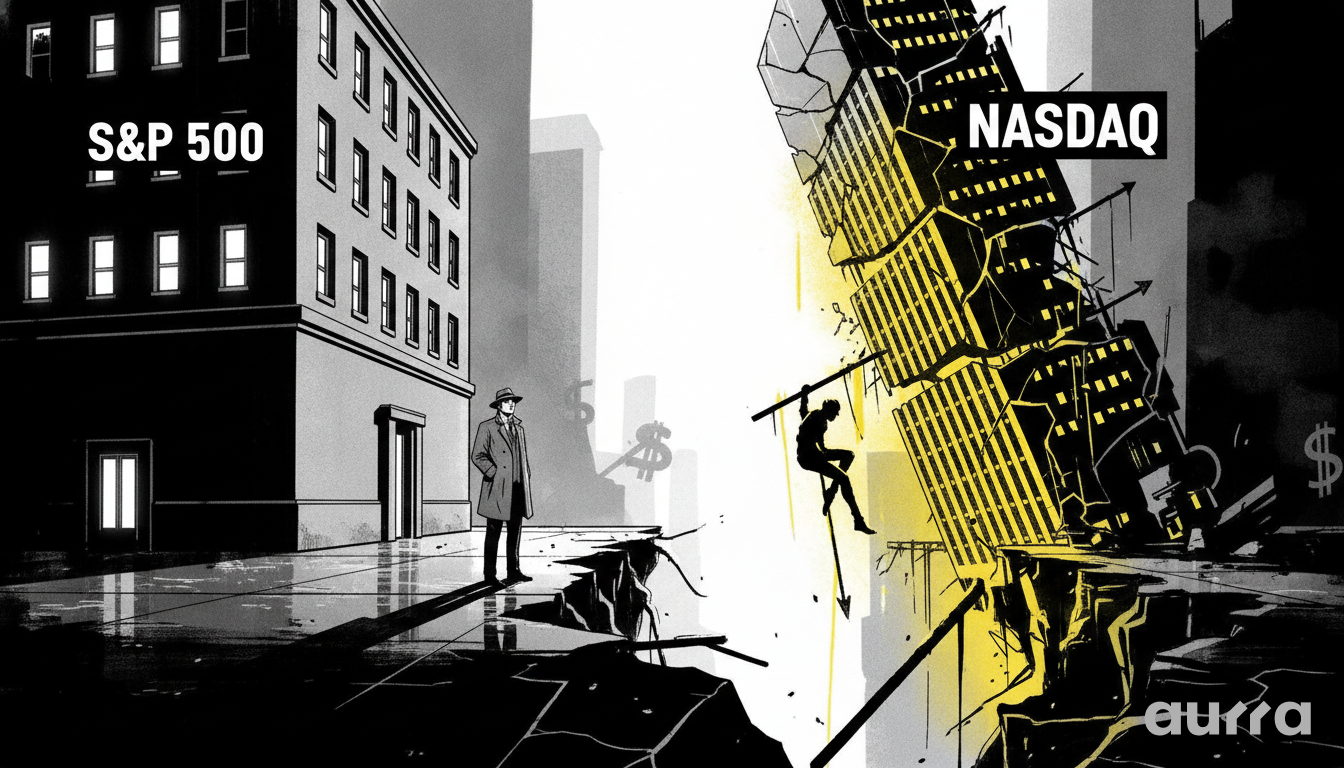
US stock indices are showing a significant divergence, with the broader S&P 500 stabilizing into a neutral phase while the tech-heavy NASDAQ remains technically vulnerable and biased to the downside. This split personality highlights a potential rotation occurring under the surface of the market, a critical early warning signal that traders must not ignore.
Reading the Market's Split Personality
While a surface-level view shows a general rebound in US equities after last week's sharp declines, a deeper technical dive reveals a fractured picture. The two leading indices are telling different stories about investor conviction and risk appetite. This divergence is a classic sign of uncertainty, where market participants are repositioning capital rather than moving uniformly in one direction.
The S&P 500's Neutral Ground
The S&P 500 has managed to neutralize its immediate bearish outlook, shifting into a phase of balance where buyers and sellers are battling for control. Its strength comes from its diversity; the index is a broad representation of the US economy, including sectors like financials, healthcare, and industrials. This composition provides a degree of insulation from the concentrated risks facing the technology sector, allowing it to find equilibrium more readily.
Why the NASDAQ Remains Under Pressure
In stark contrast, the NASDAQ's bearish bias remains intact. The index is heavily weighted towards a handful of mega-cap technology and growth stocks. These companies are acutely sensitive to changes in long-term interest rate expectations. With the market now pricing in the possibility of a Fed rate hike this year, the fundamental support for the high valuations of these tech giants is eroding, keeping sellers in a position of greater control.
In the Wild West of online finance, regulation is your safety net. We operate with strict adherence to international standards to ensure a fair trading environment.
⚖️ Trade Safely: Compliance is at the core of our business. Review our regulatory details and corporate structure at About Us.
The Unseen Force: Sector Rotation in Play
The divergence between the S&P 500 and NASDAQ is likely a textbook example of sector rotation. This is a strategic shift where investors move capital from one industry sector to another in anticipation of the next phase of the economic cycle. This is not panic selling; it is a calculated reallocation of risk.
A Flight from Growth to Value?
The current dynamic suggests a potential flight from 'growth' (the tech-centric NASDAQ) to 'value' (more traditional, stable companies found throughout the S&P 500 and the Dow Jones). When economic uncertainty rises, investors often trim their exposure to high-beta growth stocks, which are perceived as riskier, and buy into companies with more stable earnings and lower valuations. This defensive posturing is a direct response to the prevailing geopolitical and economic headwinds.
The Impact of Yields on Tech Valuations
Understanding why tech is hit hardest requires grasping a core valuation principle. Higher interest rates reduce the present value of future earnings, which disproportionately hurts growth stocks that promise large profits far in the future. As bond yields rise, the 'discount rate' used in these valuation models increases, making that distant cash flow worth less today and putting immediate pressure on the stock price.
A Trader's Roadmap: Key Levels for Both Indices
In this divergent market, a one-size-fits-all approach is ineffective. Traders must analyze each index on its own terms, identifying the unique technical levels that define the bull/bear battle lines for each.
For the S&P 500: The Bull/Bear Dividing Line
For the S&P 500, the key is to watch how it behaves around its recent consolidation zone. A hold above this area of balance would suggest that buyers are successfully absorbing selling pressure, potentially setting the stage for a push higher. However, a failure to hold this zone would indicate that the bearish sentiment from the NASDAQ is starting to bleed into the broader market, signaling that sellers are regaining the upper hand.
Timing is everything. Exclusive deposit bonuses and seasonal promotions don't last forever. If you are sitting on the fence, you might be leaving free equity on the table.
🎁 Claim Your Edge: Don't miss out on our latest offers. Secure your eligibility for our current promotions by completing your Sign Up today.
For the NASDAQ: The Must-Hold Support
The NASDAQ's situation is more precarious, and its support levels are more critical. A failure to hold its immediate support zone would confirm the prevailing bearish bias and could act as a catalyst for an accelerated wave of selling. During such high-volatility events, execution matters. Our platform's deep liquidity ensures you get your orders filled quickly and at your desired price points, which is a significant advantage when key technical levels break.
If the S&P 500 can maintain its neutral posture and eventually break to the upside, it could provide enough of a market-wide lift to pull the lagging NASDAQ up with it. Conversely, if the NASDAQ's bearish bias intensifies and it breaks down through critical support, it may signal a broader risk-off move that will ultimately drag the S&P 500 lower as well. Given this uncertainty, traders should use the Aurra Markets Trading Calculator to model potential scenarios for both long and short positions, which is essential for managing risk in a divergent market.
Key Takeaways
- A significant divergence exists: the S&P 500 is neutral while the NASDAQ remains bearish.
- This is likely evidence of sector rotation, as investors shift from growth-oriented tech to value stocks.
- The NASDAQ is more sensitive to rising interest rate expectations, explaining its underperformance.
- Each index must be traded based on its own key technical levels.
- A breakdown in the NASDAQ could eventually drag the S&P 500 down, and vice-versa.
Sector rotation is a powerful theme in the current market. Which non-tech sectors do you believe show the most promise for the remainder of the year? Let's discuss in the comments.
Risk Disclosure: Any opinions, news, research, market analysis, pricing, or other information contained on this website is provided as general market commentary for informational purposes only, and does not constitute investment advice. Aurra Markets shall not accept liability for any loss or damage, including without limitation to, any loss of profit, which may arise directly or indirectly from the use of or reliance on such information.
About Aurra Markets
Retail traders need institutional conditions. Aurra Markets links your MT5 terminal directly to deep liquidity pools. This means you trade with lower spreads and zero requotes. We operate as a pure digital broker with instant USDT deposits.
Access our full asset list at www.aurra.markets.
🛡️ Security Verification:
You are trading with Aurra Markets International. We are a distinct, independent financial institution. We are not associated with 'Aura FX', 'Auro Markets', 'Aurora', or 'Aura Funded'. Always verify your URL: Ensure you are connected to the official www.aurra.markets.