Back
Back



EUR/USD at a Crossroads: What Will Drive the Next Breakout?
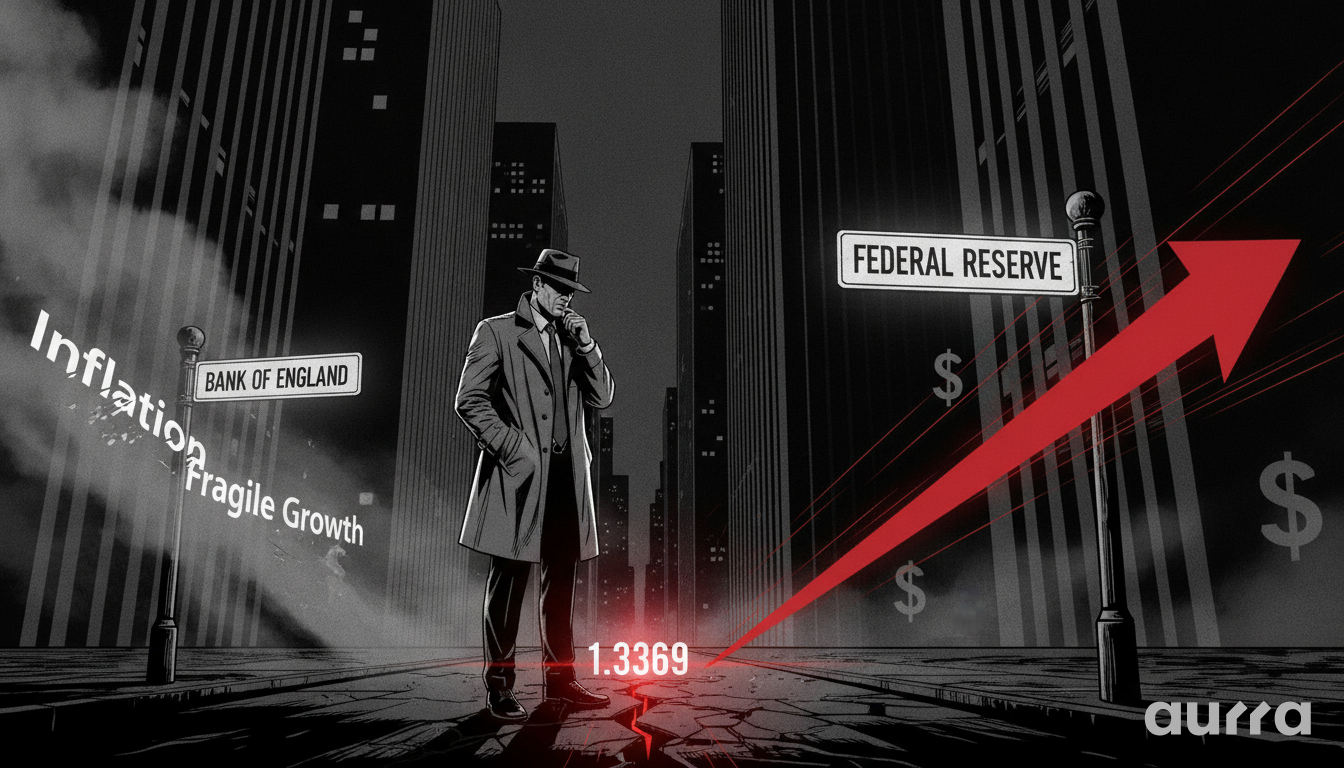
The EUR/USD is caught in a tight consolidation pattern as the market braces for a high-stakes showdown between the Federal Reserve and the European Central Bank. This divergence in monetary policy is creating significant uncertainty, pinning the pair around the critical 1.1600 level and making the upcoming Fed decision the primary catalyst for the next directional move.
This situation is a classic example of a market pricing in conflicting macroeconomic signals, a scenario we last saw with such clarity during the sovereign debt crisis. Back then, the ECB's dovish actions contrasted sharply with a more stable Fed, causing a multi-month downtrend. Today, while the context is different, the principle is the same: capital flows will follow the central bank that offers the most compelling yield and stability narrative. The current tension is amplified by the US-German 10-year yield spread, which has historically been a highly reliable leading indicator for EUR/USD. A widening of this spread, signaling stronger relative returns in the US, almost invariably precedes a leg down in the currency pair. Therefore, traders should be watching this spread as closely as the spot price for clues on institutional money flow.
Fundamental Crosscurrents: Fed vs. ECB
The core of the market's current paralysis lies in the opposing signals from the world's two most influential central banks. While one appears committed to a hawkish path to manage inflation, the other is forced to balance inflation concerns with looming risks of economic stagnation, creating a fascinating tug-of-war for currency traders.
The Federal Reserve's Hawkish Stance
The Fed remains the dominant force in this equation. With recent inflation data coming hotter than expected, the market anticipates a 'higher-for-longer' message. This hawkish stance supports a strong dollar, as higher interest rates attract foreign capital seeking better returns. The upcoming policy announcement is not just about the rate decision itself, but more critically, about the forward guidance and the dot plot, which will signal the Fed's future intentions and could trigger significant dollar buying.
ECB's Cautious Neutrality
Conversely, the European Central Bank is in a much more precarious position. The Eurozone economy is facing significant headwinds, from energy supply risks stemming from geopolitical tensions to signs of slowing industrial production in its powerhouse, Germany. This forces the ECB to adopt a more cautious, almost neutral stance. Any aggressive tightening to match the Fed could risk tipping the fragile economy into recession, limiting the ECB's ability to support the Euro through higher rates.
Energy Prices and Geopolitical Overlays
The ongoing geopolitical tensions in the Middle East add another layer of complexity, particularly for Europe. The Eurozone's high dependency on imported energy makes it vulnerable to price spikes, which act as a direct tax on consumers and businesses, dampening economic growth. A sharp rise in oil prices would not only worsen the Eurozone's economic outlook but also likely trigger a flight to safety, further benefiting the US dollar as the world's primary reserve currency.
Choosing the right account type is just as important as choosing the right strategy. While many brokers offer a one-size-fits-all solution, we believe in specificity.
💡 Trader Tip: We recommend comparing the spread and commission structures on our Trading Accounts page to ensure you are using the setup that maximises your opportunities.
Technical Landscape: A Market in Equilibrium
From a charting perspective, the EUR/USD is perfectly coiled, reflecting the fundamental uncertainty. The price action is trapped between well-defined technical levels, suggesting that neither buyers nor sellers have the conviction to take control until a new catalyst emerges.
Key Support and Resistance Zones
The market is currently pivoting around the 1.1600 level. Immediate support is found near the 50-day EMA at 1.1580, a level that has held on recent tests. A break below this would open the door to a deeper correction. On the upside, significant resistance is capped by the 200-day SMA around 1.1750. This long-term moving average represents a major psychological and technical barrier that will require substantial buying pressure to overcome.
Moving Average Analysis: The Squeeze
The convergence of the 50-day and 200-day moving averages signifies a market in consolidation, or a 'squeeze.' This technical formation often precedes a period of high volatility and a strong directional breakout. The longer the price remains sandwiched between these averages, the more powerful the eventual move is likely to be. Our deep liquidity at Aurra Markets ensures that when this breakout occurs, traders can get their orders filled with minimal slippage.
Volume and Open Interest Signals
Recent volume patterns confirm the market's indecision. Trading volumes have been subdued, indicating that large institutional players are waiting on the sidelines ahead of the Fed's announcement. There hasn't been an aggressive build-up of either long or short positions, suggesting that traders are positioned defensively. This lack of commitment underscores the high-risk nature of taking a strong directional view before Wednesday's event.
Broader Market Impact and Trader Positioning
The fate of EUR/USD is not being decided in a vacuum. Its direction will be heavily influenced by broader market sentiment, yield differentials, and the resulting capital flows between the US and Europe.
US-German Yield Spread: The Ultimate Barometer
As mentioned, the spread between US 10-year Treasury yields and German 10-year Bund yields is a critical indicator. When this spread widens (US yields rising faster than German yields), it makes holding dollar-denominated assets more attractive, pulling capital away from the Euro. Astute traders watch this spread for early warnings of a shift in momentum. A decisive move in the spread following the Fed's announcement will likely confirm the subsequent direction of EUR/USD.
Risk Sentiment and Cross-Asset Correlations
The broader risk environment also plays a crucial role. In a 'risk-off' scenario, where global uncertainty rises, investors typically flock to the safety of the US dollar. Geopolitical flare-ups or signs of a sharp global economic slowdown would therefore act as a headwind for EUR/USD. Conversely, a 'risk-on' environment, characterized by optimism and a search for yield, would be more supportive of the Euro.
If the Federal Reserve delivers a hawkish statement on Wednesday, confirming its commitment to fighting inflation, expect the US-German yield spread to widen and the EUR/USD to make a decisive break below the 1.1580 support level. Traders can stay ahead of this high-impact event by keeping a close eye on ours Aurra Markets Economic Calendar. This is a critical moment where managing costs is key, which is why our platform's highly competitive, low-cost spreads on our Standard and ECN accounts offer a direct advantage in volatile conditions.
🔒 Institutional-Grade Security
We protect your capital using strict security protocols. Your digital assets are secured by heavy-duty cold storage infrastructure and end-to-end encryption. You can view your balances safely within the integrated wallet ecosystem.
Key Takeaways
- EUR/USD is consolidating around the 1.1600 level due to conflicting monetary policy signals from the Federal Reserve (hawkish) and the ECB (cautious).
- The upcoming Fed policy decision is the primary catalyst expected to break the current deadlock.
- The US-German 10-year yield spread is a critical leading indicator for institutional money flow and the future direction of the pair.
- Technically, the pair is squeezed between the 50-day EMA (1.1580 support) and the 200-day SMA (1.1750 resistance), often a precursor to a volatile breakout.
The EUR/USD is poised for a significant move post-Fed announcement. Which technical levels are you watching, and what's your game plan for managing the potential volatility? Share your thoughts in the comments below.
Risk Disclosure: Any opinions, news, research, market analysis, pricing, or other information contained on this website is provided as general market commentary for informational purposes only and does not constitute investment advice. Aurra Markets shall not accept liability for any loss or damage, including without limitation to, any loss of profit, which may arise directly or indirectly from the use of or reliance on such information.
About Aurra Markets
Retail traders need institutional conditions. Aurra Markets links your MT5 terminal directly to deep liquidity pools. This means you trade with lower spreads and zero requotes. We operate as a pure digital broker with instant USDT deposits.
Access our full asset list at www.aurra.markets.
The Official Aurra Markets:
There is only one Aurra. We are defined by our Double-R spelling and our commitment to transparency. ❌ Not a prop firm. ❌ Not affiliated with Aura Capital. ✅ We are a fully registered International Brokerage (Reg: 2025-00208).