Back
Back


Why Did WTI Crude Oil Prices Fall Despite Middle East Tensions?
WTI crude oil Futures experienced a significant drop of over 3%, settling at $88.20 after a volatile session that saw a wide trading range between $85.95 and $91.55. This downturn occurred despite escalating geopolitical tensions, indicating that demand-side fears are currently overriding the traditional supply-risk premium in the minds of traders.
Market Dynamics: Geopolitics vs. Economic Fears
The price action in the oil market has been counterintuitive, highlighting a crucial shift in focus from supply risks to global demand concerns. Typically, heightened conflict in the Middle East would send crude prices soaring. However, the market's muted and even negative reaction suggests that deeper economic anxieties are now the primary driver of price.
The Geopolitical Factor Fades
Despite news of a US helicopter being shot down by an Iranian drone, oil prices failed to sustain any rally. Instead of pricing in a higher risk premium for potential supply disruptions in the Strait of Hormuz, the market sold off. This signals that traders may be viewing the current geopolitical climate as contained, with a lower probability of escalating into a full-blown conflict that would significantly impact oil supply chains.
Demand Concerns Take Center Stage
The sharp decline points to growing concerns about the health of the global economy. Fears of interest rate hikes in the US, as discussed in our equity market analysis, can lead to expectations of slower economic growth. Slower growth translates directly to lower demand for energy, putting downward pressure on crude oil prices. The market is now weighing the tangible threat of a hawkish central bank more heavily than the potential threat of supply disruptions.
Forex pairs can be slow, but Indices like the NASDAQ or DAX offer high volatility movement for day traders looking for quick opportunities.
📊 Find the Volatility: If the currency markets are flat, look elsewhere. Discover the most volatile assets to trade right now on our global Markets page.
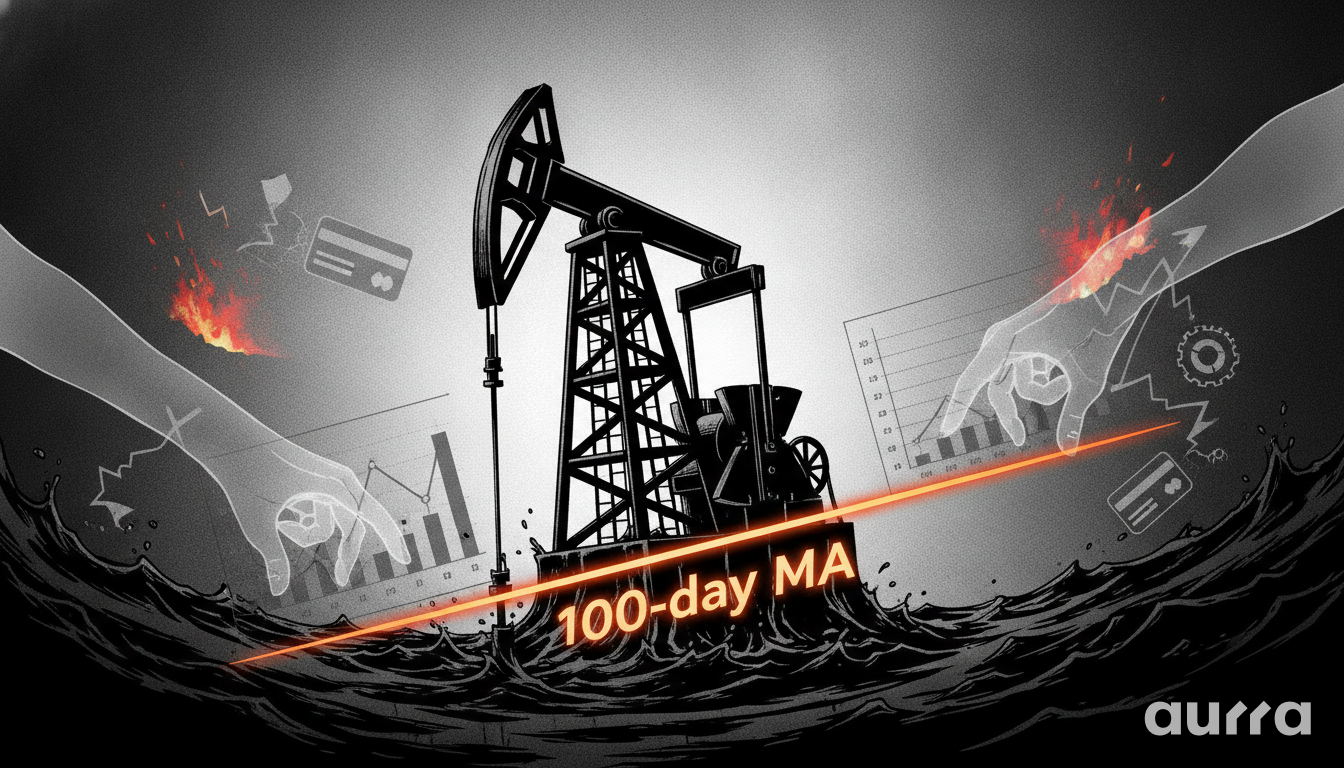
Technical Analysis: The Battle for the 100-Day MA
From a technical standpoint, WTI crude oil is now at a critical juncture, with key long-term indicators coming into play. The recent price action has brought the market to a technical crossroads that could determine the trend for the coming weeks.
Support at the 50% Retracement
During the session, the price dipped below the 50% Fibonacci retracement level of the recent move up from the December low, which sits at $87.34. While the price did not close below this level, the test indicates significant selling pressure and an attempt by bears to take control of the market.
The Critical 100-Day Moving Average
The day's low of $85.95 came just shy of the 100-day moving average (MA) at $85.66. This moving average is a widely watched indicator of the medium-term trend. The last time the price was below this level was in late January. A sustained break and close below the 100-day MA would be a significant bearish signal, suggesting that a deeper correction is likely.
Resistance on the Upside
For the bullish case to regain traction, buyers would need to push the price back above the 50% retracement level and then challenge the session high of $91.55. Until then, the path of least resistance appears to be to the downside, with sellers likely to be active on any rallies.
The first Friday of every month brings the Non-Farm Payrolls (NFP) - the most volatile event in Forex. It can be a profit opportunity or a risk trap.
📉 Trade the Data: Are you ready for the next NFP release? Check the consensus forecast and the exact release time on our Economic Calendar.
Trader Playbook: Navigating Oil's Next Move
This is a challenging but opportunity-rich environment for energy traders. The divergence between geopolitical headlines and price action requires a data-grounded approach and a clear understanding of risk management.
Cost Management in Volatile Conditions
The wide trading range in WTI is a reminder that volatility can increase trading costs. In these conditions, utilizing a platform with highly competitive, low-cost spreads is a core advantage. It allows you to navigate the chop without giving up significant edge to transaction fees. At Aurra Markets, we provide direct interbank pricing to ensure our traders operate with maximum cost-efficiency.
Cross-Asset Correlation to Watch
As oil prices fall, traders should closely monitor the inverse effect on commodity currencies, particularly the Canadian Dollar. A breakdown in WTI below the 100-day MA could signal a significant rally in the USD/CAD pair. This cross-asset awareness provides another avenue for potential opportunities.
Scenario Planning with Aurra Tools
If oil breaks below the $85.66 level, expect accelerated selling. You can prepare for this by setting price alerts directly on the MetaTrader 5 (MT5) platform. Furthermore, given the high stakes, using our Trading Calculator is essential to model potential trade scenarios and manage your position sizing according to your risk tolerance.
Key Takeaways
- WTI crude oil fell over 3% to settle at $88.20, driven by economic demand fears that overshadowed geopolitical supply risks.
- The price tested the 50% Fibonacci retracement level and approached the critical 100-day moving average at $85.66.
- A break below the 100-day MA would be a significant bearish technical signal for the medium-term trend.
- The market's negative reaction to heightened Middle East tensions indicates a major shift in focus towards global economic health.
How are you positioning for the next major move in oil? Do you see it holding the 100-day MA or breaking lower?
Risk Disclosure: Any opinions, news, research, market analysis, pricing, or other information contained on this website is provided as general market commentary for informational purposes only and does not constitute investment advice. Aurra Markets shall not accept liability for any loss or damage, including without limitation to, any loss of profit, which may arise directly or indirectly from the use of or reliance on such information.
Aurra Markets: Institutional Execution
Access raw spreads and fast execution speed as fast as 12ms on the MetaTrader 5 platform. We offer direct Crypto and Fiat funding for fast market entry. No hidden fees. No requotes.
Visit the official site at www.aurra.markets.
The Official Aurra Markets:
There is only one Aurra. We are defined by our Double-R spelling and our commitment to transparency. ❌ Not a prop firm. ❌ Not affiliated with Aura Capital. ✅ We are a fully registered International Brokerage (Reg: 2025-00208).